
The Rebirth of the Excelsior: A $8.3M Second Act for Charlotte's Historic West End Landmark |
Charlotte's iconic Excelsior Club is set for an $8.3 million revival. Explore its Green Book history, redevelopment plans, timeline, and impact on Charlotte's Historic West End. |
Quick Facts
📍 Location: 921 Beatties Ford Road, Charlotte, NC 🏛 Founded: 1944 📖 Official Green Book Site 🎷 Hosted Nat King Cole, Louis Armstrong & James Brown 💰 $8.3 Million Redevelopment Investment 🏗 Demolition Expected: Summer 2026 🎉 Target Reopening: 2028–2029
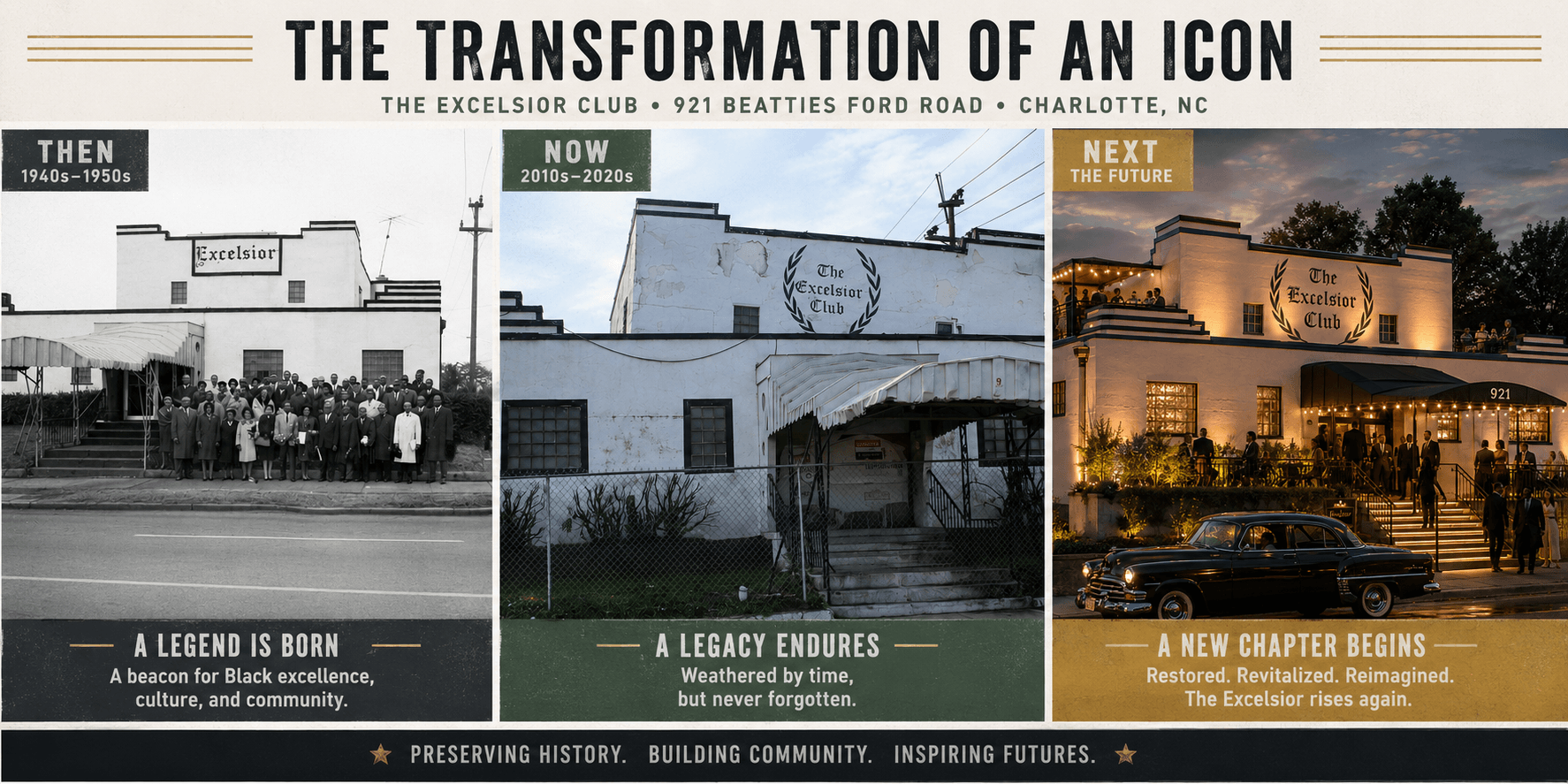
For years, the building at 921 Beatties Ford Road has sat quietly along one of Charlotte's most historic corridors. Its weathered facade and boarded windows stand in sharp contrast to what it once represented: one of the most important cultural gathering places in the Southeast.
Now, after nearly a decade of uncertainty, the historic Excelsior Club is preparing for a comeback.
Backed by an $8.3 million redevelopment effort, the West End landmark is expected to be rebuilt as a near replica of the original structure, preserving its historic character while creating a new destination for future generations.
For many Charlotte residents, the project represents more than a renovation. It represents the preservation of a piece of the city's history that nearly disappeared.
A Legacy That Began in 1944
The Excelsior Club was founded by James "Jimmie" McKee in 1944 during a time when segregation limited where Black residents and travelers could gather.
What started as a social club quickly became one of the premier Black-owned entertainment venues in the Southeast. The club offered a safe, welcoming environment for professionals, business owners, educators, civic leaders, and travelers during the Jim Crow era.
The Excelsior eventually earned a place in the Negro Motorist Green Book, making it a recognized destination for Black travelers seeking safe accommodations and entertainment while traveling throughout the South.
Today, the club remains one of Charlotte's most important surviving symbols of African American history and culture.
Where Legends Performed
The Excelsior's stage hosted some of the biggest names in American music.
Performers including Nat King Cole, Louis Armstrong, James Brown, Duke Ellington, and many other legendary entertainers appeared at the club throughout its history.
The venue also became a gathering place for political leaders and community organizers. If you wanted to reach Charlotte's Black community, the Excelsior was often where conversations began.
Its influence extended well beyond entertainment. The club played a meaningful role in Charlotte's civic and political history for decades.
In 1992, presidential candidates Bill Clinton and Al Gore visited the Excelsior Club during their campaign, highlighting its status as one of the most influential gathering places in the city.
Additional historical information can be found through the Historical Marker Database and reporting from WFAE Charlotte.
The $8.3 Million Redevelopment Plan
After closing in 2016, years of neglect left the structure in significant disrepair.
Because of the building's deteriorated condition, the existing structure is expected to be demolished and rebuilt while closely replicating the original Art Deco design that generations of Charlotte residents remember.
The redevelopment effort is being led by local development partners and includes funding from both public and private sources.
Developers have repeatedly emphasized that the goal is not to replace the Excelsior with something entirely new. Instead, the objective is to preserve the building's identity while creating a modern facility that can serve the community for decades to come.
The project represents one of the most significant historic preservation efforts currently underway in Charlotte's Historic West End.
What the New Excelsior Will Include
Current plans call for a mixed-use cultural destination that combines dining, entertainment, education, and community programming.
The vision is to create more than a restaurant. Developers hope to build a destination that celebrates history while serving the future of Charlotte's Historic West End.
Why This Matters for the West End
The Excelsior's return comes during a period of significant investment along the Beatties Ford Road corridor.
New businesses, infrastructure improvements, housing projects, and community investments have helped bring renewed attention to Charlotte's Historic West End.
For many residents, however, preserving the neighborhood's identity remains just as important as attracting new development.
The Excelsior project stands out because it combines economic investment with historic preservation, ensuring that one of Charlotte's most important cultural landmarks remains part of the neighborhood's future.
Projects like this often increase community pride, support nearby businesses, improve walkability, and strengthen long-term investment in surrounding neighborhoods.
What's Next?
Current plans call for demolition and site preparation to begin in Summer 2026, followed by reconstruction and interior build-out over the next several years.
Major construction is expected throughout 2027 and 2028, with the museum, restaurant, and community spaces taking shape during the final phases of the project.
If timelines remain on track, the Excelsior Club could welcome guests once again sometime between 2028 and 2029.
When those doors reopen, it won't simply mark the return of a building.
It will mark the return of one of Charlotte's most significant cultural institutions.
The Bottom Line
The Excelsior Club was never just a nightclub.
It was a gathering place. A stage. A political hub. A source of opportunity during a time when opportunities were often limited.
For generations of Charlotte residents, it represented excellence, community, and culture.
Its rebirth represents more than construction. It represents a commitment to preserving Charlotte's history while investing in its future.
And for the Historic West End, that may be one of the most important comeback stories unfolding anywhere in the city.
|
0 Comments
Join the conversation
Be the first to comment
Share your thoughts above.