A 100-Year-Old Uptown Building Could Soon Become a Data Center |
Charlotte’s Court Arcade demolition shows the tension between historic preservation, tech growth, and what City Council can actually stop. |
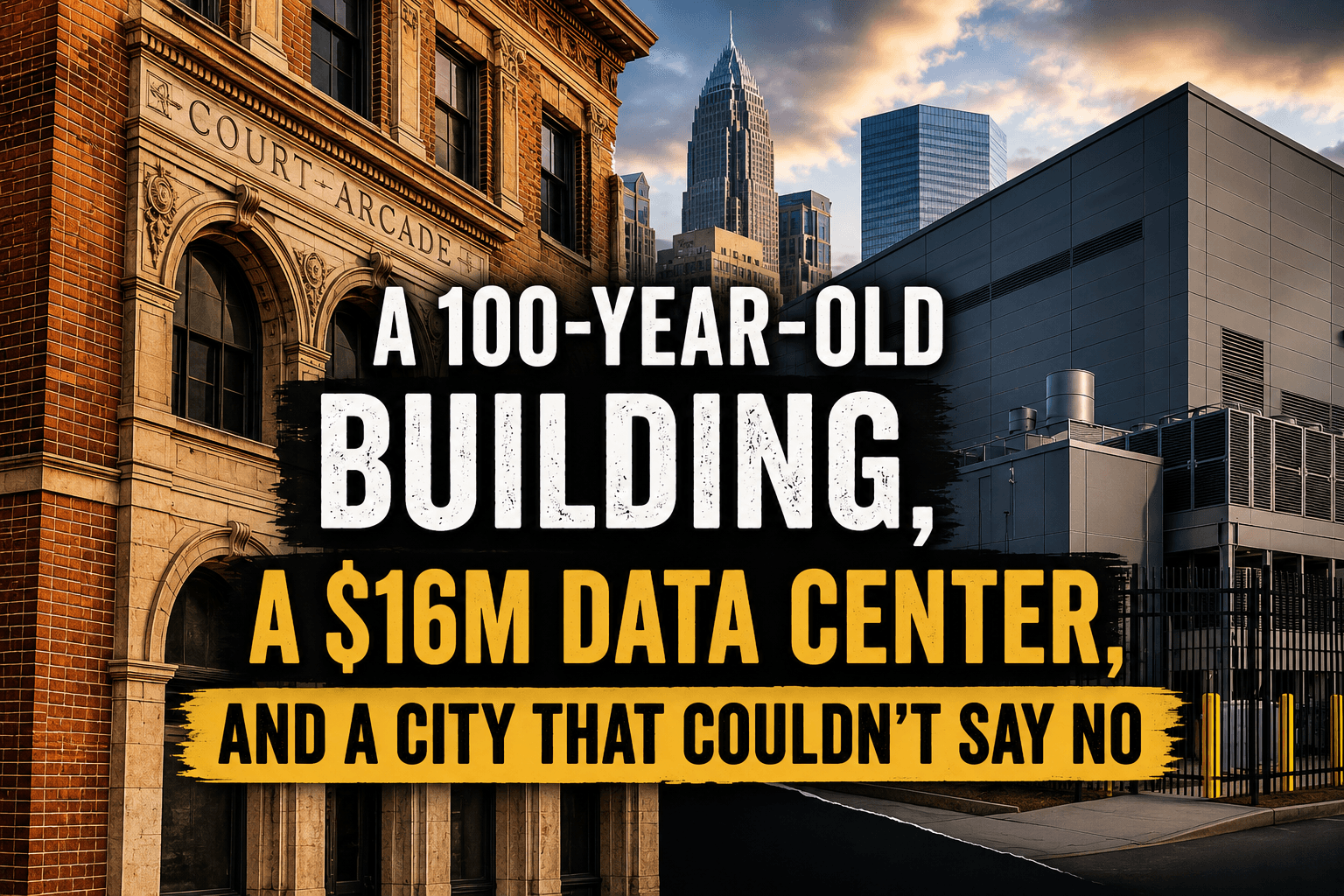
If you’ve spent any time walking the blocks of Uptown Charlotte near the courthouse, you may know the building at 725 E. Trade St.
The Court Arcade is not a flashy skyscraper. It is one of those “old Charlotte” buildings that gives Uptown texture. Built in the mid-1920s, the Classical Revival building has arched entryways and a skylit interior walkway that feels like a quiet passage through the city’s past.
For decades, it served lawyers, court staff and others who worked around the Mecklenburg County Courthouse.
But now, the 100-year-old building is slated for demolition. In its place: a four-story data center.
This is not just a story about one building coming down. It is a story about how Charlotte grows, what local government can and cannot stop, and why preservation often loses before most residents even know there is a fight.
What’s happening at 725 E. Trade St.?
In March 2024, Digital Realty Trust purchased the Court Arcade parcel and an adjacent lot for $16 million.
The purchase made sense from a business standpoint. Digital Realty already operates a large data center next door at 113 N. Myers St. The new project would expand its Uptown footprint.
At first, there was some hope that part of the historic building could be saved. Digital Realty met with the Charlotte-Mecklenburg Historic Landmarks Commission and discussed preserving the arched facade.
But in June 2026, the company filed a new demolition permit for full removal.
Why people care about the Court Arcade
The Court Arcade was designed by William H. Peeps, the same architect behind Latta Arcade.
That matters because buildings like this help Charlotte feel like Charlotte. They are not always grand landmarks, but they give the city character. They remind people that Uptown was not always glass towers, parking decks and new apartments.
The Court Arcade survived urban renewal, banking booms and wave after wave of redevelopment. Now it may be replaced by server rooms, cooling systems and backup generators.
The moratorium problem
Here is where the timing gets frustrating.
On June 8, 2026, Charlotte City Council voted 11-0 to approve a 150-day moratorium on new data center development.
The pause was meant to give the city time to review how data centers affect neighborhoods, power use, water demand, noise and land use.
But the moratorium does not stop projects that were already in motion.
Because Digital Realty’s plans were filed before the vote, the project is considered grandfathered in. In simple terms: the pause button came too late for this site.
Why the city may not be able to say no
This is the part every Charlotte resident should understand.
Some projects are allowed by-right. That means if the property owner follows the existing zoning rules and building codes, the city may not have the ability to block the project through a public vote.
In those cases, the permit process becomes more technical than political. If the plans meet the rules already on the books, the city often has to allow the project to move forward.
What is being built?
After demolition, Digital Realty plans to build a four-story, 12-megawatt data center.
The project is expected to include server space, cooling systems, backup power and a mechanical yard. It will function less like a traditional office building and more like critical digital infrastructure.
For Digital Realty, the project is a logical expansion. For preservation advocates, it is another example of Charlotte losing older buildings before stronger protections are in place.
The bigger picture for Charlotte
This story captures one of Charlotte’s biggest tensions.
The city wants tech investment. It wants infrastructure. It wants to be competitive in a digital economy.
But Charlotte also wants to preserve its history, protect neighborhoods and avoid becoming a city where every older building is treated like a placeholder for the next larger project.
That tension is not going away.
Data centers are part of modern life. They support cloud storage, streaming, artificial intelligence, remote work and the digital tools people use every day.
But they also raise real questions about land use, energy demand, water consumption and whether the highest-value use of Uptown land should be windowless infrastructure.
The bottom line
The Court Arcade demolition is a reminder that preservation usually has to happen early.
By the time a demolition notice appears, the important decisions may have already been made months or years before.
The city’s data center moratorium may shape future projects, but it likely will not save this building.
For Charlotte residents, the bigger question is this:
Do we have the right tools to protect the buildings that give the city its character, or are we only reacting once the clock has already run out?
Takeaway for the smart neighbor:
📍 Want to learn more? Check out the City of Charlotte’s Data Centers Moratorium FAQ page.
For more updates on how development is changing Charlotte, visit the Queen City Scoop news section. |


0 Comments
Join the conversation
Be the first to comment
Share your thoughts above.