
No Toll Lanes Needed? A New Plan for I-77 South |
Sustain Charlotte proposes a 9-point plan to ease I-77 South congestion without toll lanes, including ramp metering, express buses and transit expansion. |
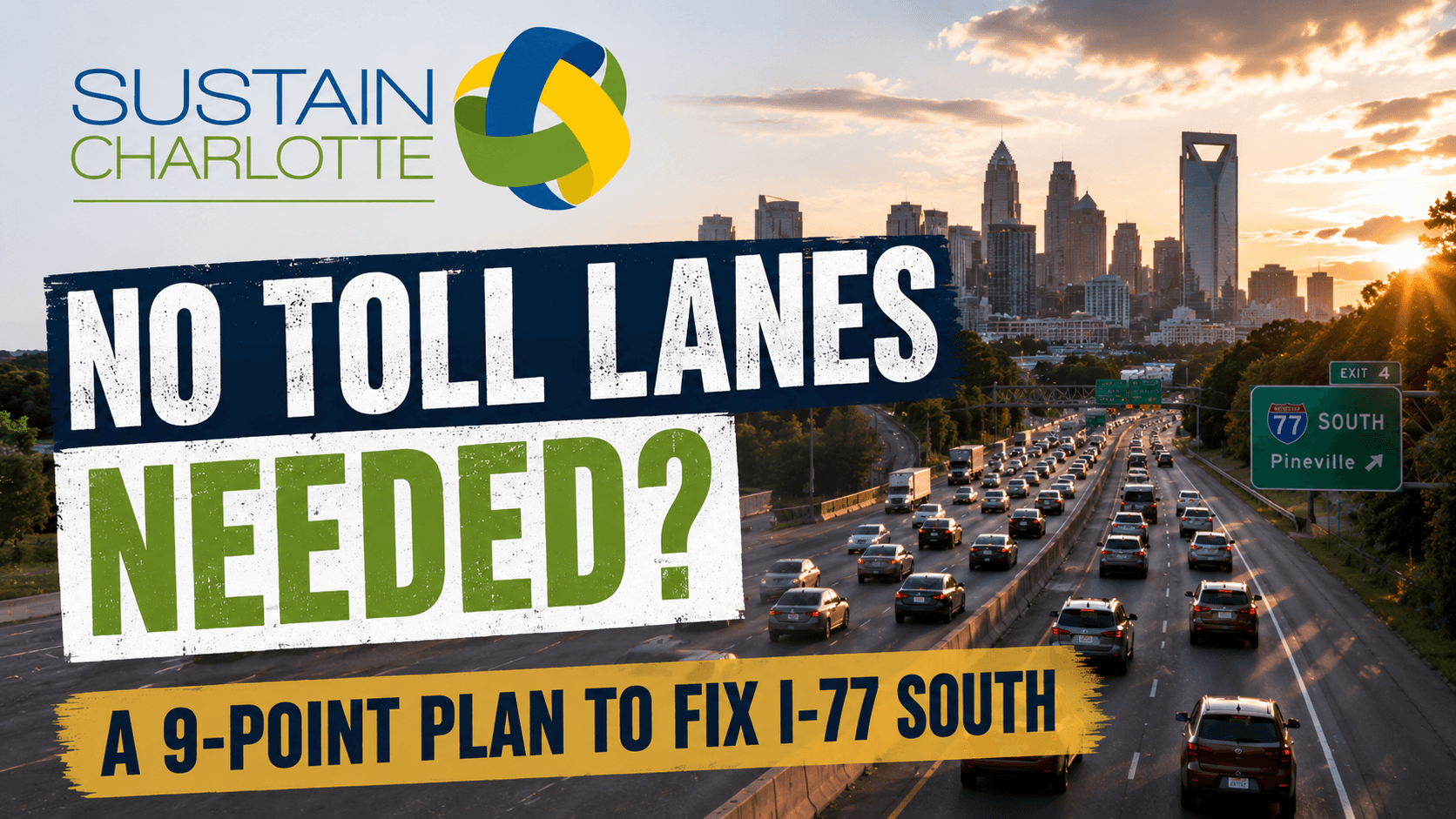
Traffic on I-77 South has become one of Charlotte's most talked-about frustrations. As the region continues to grow, so has the debate over how to move hundreds of thousands of commuters more efficiently every day.
For years, expanding toll lanes dominated the conversation. Now, a new proposal suggests there may be another path forward.
Sustain Charlotte has released a comprehensive 50-page plan outlining nine strategies to improve traffic flow, expand transit and reduce congestion without adding new toll lanes.
Quick Take The proposal combines short-term operational improvements with long-term transportation investments, including smarter traffic management, expanded express bus service, future rail connections and redesigned highway interchanges.
The report comes just months after the Charlotte Regional Transportation Planning Organization (CRTPO) voted to withdraw its support for expanding toll lanes on I-77 South. That decision effectively reset one of the region's largest transportation debates and opened the door for alternative solutions.
WBTV first reported on the proposal following its release.
A New Direction After Years of Debate
Instead of asking whether Charlotte should build more toll lanes, Sustain Charlotte is asking a different question.
What if congestion could be reduced by improving how the existing highway operates while investing in better transit and regional mobility?
Executive Director Shannon Binns says the region does not have to wait years for one massive highway project before seeing meaningful improvements.
Rather than relying on a single billion-dollar solution, the organization recommends a series of smaller projects that can begin improving traffic sooner while building toward larger transportation investments over the next 15 years.
Big Picture Instead of treating congestion as only a highway problem, the proposal approaches it as a regional transportation challenge involving roads, transit, employer partnerships and land use.
The $60 Million Question
Although the toll lane project has lost regional support, the financial questions surrounding it have not disappeared.
The proposed North Carolina state budget includes language requiring Charlotte to reimburse approximately $60 million to the North Carolina Department of Transportation for planning work already completed on the toll lane project.
Charlotte leaders have criticized that provision, arguing residents should not be penalized for changing course after years of public debate.
The disagreement has created a political standoff between state and local leaders while commuters continue dealing with daily backups along one of the region's busiest corridors.
QC News has also been following both the funding dispute and Sustain Charlotte's proposal.
Inside the 9-Point Plan
Sustain Charlotte's recommendations are divided into projects that can begin relatively quickly and larger investments that would require years of planning.
1. Ramp Metering 2. Modernize Existing Interchanges 3. Active Traffic Management 4. Bus-on-Shoulder Operations 5. Expanded Regional Express Bus Service 6. Transportation Demand Management 7. Advance the Blue Line South 8. Explore Regional Commuter Rail 9. Study Highway Caps and Tunnels
Why It Matters
For many Charlotte-area residents, transportation costs extend far beyond fuel.
Time spent sitting in traffic affects work schedules, childcare, family time and overall quality of life. If toll lanes become the primary way to guarantee a predictable commute, those costs can quickly add up for households traveling the corridor every day.
Sustain Charlotte argues that investing in better operations, stronger transit and additional travel choices creates benefits for a wider range of commuters instead of only those willing or able to pay tolls.
The proposal also reflects how rapidly Charlotte continues to grow. More residents, new employers and continued development across southern Mecklenburg County mean transportation decisions made today will shape the region for decades.
The Bottom Line
The debate over I-77 South is no longer simply about whether Charlotte should build more toll lanes.
It has become a broader conversation about how one of America's fastest-growing metro areas should invest in transportation.
Sustain Charlotte's proposal offers one possible roadmap built around operational improvements, expanded transit and long-term regional planning. Whether those ideas ultimately replace the toll lane strategy remains to be seen, but they have already reshaped the conversation.
What do you think? Would you rather see Charlotte invest in better transit and smarter traffic management, or do you think additional toll lanes are still the fastest way to improve I-77 South? Let us know your thoughts. |


0 Comments
Join the conversation
Be the first to comment
Share your thoughts above.